Genomic Alterations in Advanced Lung Cancer Patients Compared via CGP and Hotspot Panel Test in a Bangladeshi Tertiary Hospital
Dr. Md. Arifur Rahman
Oncology Specialist
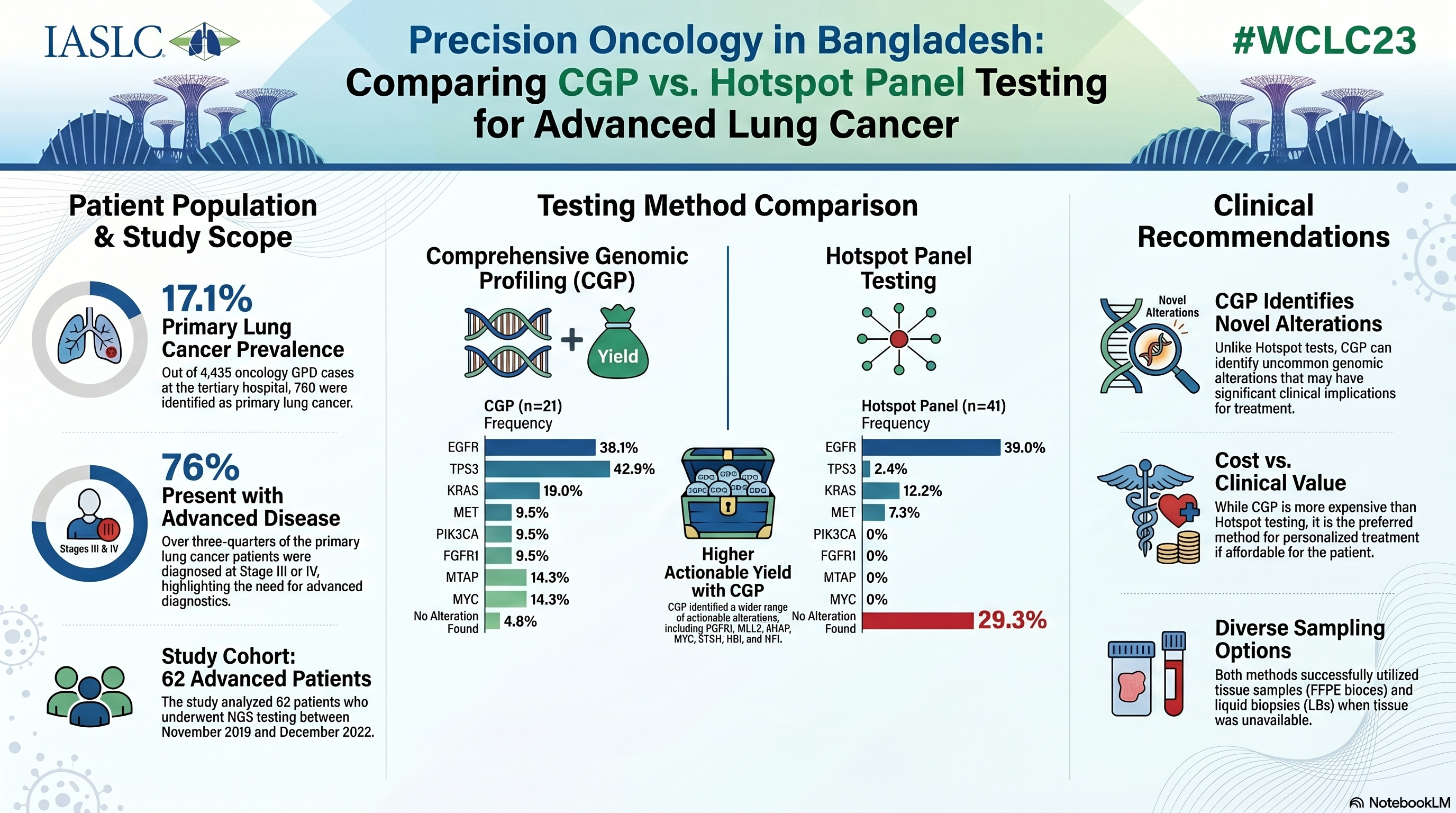
The provided sources describe a **retrospective observational study** conducted at **Bangladesh Specialized Hospitals Limited**. The study focused on the genomic landscape of advanced lung cancer patients in Bangladesh, specifically comparing two **Next-Generation Sequencing (NGS)** methods. ### **Objective and Methodology** The primary aim was to compare the frequency of genomic alterations identified by **Comprehensive Genomic Profiling (CGP)** and **Hotspot panel tests** in patients with advanced lung cancer. * **Data Set:** Researchers analyzed 4,435 oncology outpatient department (OPD) cases, identifying **760 (17.1%) as primary lung cancer** cases. * **Sample Selection:** Of these lung cancer cases, **76% presented in advanced stages (III-IV)**. * **Testing Group:** The study specifically examined reports from **62 advanced lung cancer patients** who underwent NGS testing between November 2019 and December 2022. * **Method Distribution:** **21 patients** were tested using **CGP**, while **41 patients** were tested using the **Hotspot panel**. ### **Key Findings** The study highlighted significant differences in the efficacy of the two testing methods: * **Detection Rate:** The probability of identifying **no genomic alterations** was much higher with the **Hotspot panel (29.3%)** compared to **CGP (4.8%)**. * **Actionable Alterations:** CGP identified a broader range of **actionable genomic alterations**, including *FGFR1, MLL2, MTAP, MYC, STK11, RB1, NF1, PIK3CA, ARID1A, CCND1,* and *BRCA1/2*. * **Common Mutations:** Both methods showed similar frequencies for common mutations like ***EGFR*** (approximately 38-39%) and ***ALK*** (approximately 5-7%). However, CGP was significantly better at detecting ***TP53*** alterations (42.9% vs. 2.4% for Hotspot). ### **Conclusions and Implications** The researchers concluded that **CGP is superior** to Hotspot panel testing because it has a higher probability of detecting actionable and novel alterations that can inform **personalized treatment approaches**. * **Clinical Preference:** Despite its higher cost, the study recommends **CGP as the preferred method** for patients who can afford it. * **Future Research:** The authors note that the study's **sample size is limited** and may not represent the entire country's population. Consequently, **larger studies** are needed to establish official guidelines for genomic testing in advanced lung cancer patients across Bangladesh.